University of Science and Arts of Oklahoma Student Union
 | |
| Motto | "College for the Curious Listen" |
|---|---|
| Type | Public liberal arts university |
| Established | 1908 |
| Endowment | $27,000,000[1] |
| President | John Feaver |
| Students | 800[2] |
| Location | Chickasha Oklahoma United States |
| Campus | Small town |
| Colors |
|
| Nickname | Drovers |
| Sporting affiliations | NAIA – SAC |
| Mascot | Dusty the Drover |
| Website | www |
 | |
| Oklahoma College for Women Historic District | |
| U.S. National Register of Historic Places | |
| U.S. Celebrated district | |
 | |
| Show map of Oklahoma Evidence map of the Us | |
| Location | Roughly bounded past Grand Ave., 19th St., Alabama Ave., and alley w of 15th St., Chickasha, Oklahoma |
| Area | 50 acres (twenty ha) |
| Built | 1911 (1911) |
| Architect | Smith & Parr; Donathan & Moore |
| Architectural fashion | Classical Revival, Mission/Spanish Revival |
| NRHP referenceNo. | 01000950[3] |
| Added to NRHP | September 9, 2001 |

The Academy of Science and Arts of Oklahoma (USAO) is a public liberal arts university in Chickasha, Oklahoma. Information technology is the only public higher in Oklahoma with a strictly liberal arts–focused curriculum and is a member of the Council of Public Liberal Arts Colleges.[4] USAO is an undergraduate-only establishment and grants bachelor's degrees in a variety of subject areas. The school was founded in 1908 every bit a school for women and from 1912 to 1965 was known every bit Oklahoma Higher for Women. Information technology became coeducational in 1965 and today educates approximately 800 students. In 2001, the entire Oklahoma Higher for Women campus was listed as a national celebrated commune.[3] [five]
History [edit]
After Oklahoma was admitted to statehood in 1907, the new state legislature was tasked with establishing institutions of college education in the one-time Indian Territory.[6] Statistics gathered past the Land Superintendent of Teaching showed that many immature women from Oklahoma chose to attend women's colleges in Kansas, Texas, and Missouri.[7] Colonel J. T. O'Neil, the state senator from Grady County, and his girl, Anne Wade O'Neil, who had graduated from a women'southward college in Mississippi, appealed to the legislature to authorize the creation of a women'due south college.[7] The University was founded on May 16, 1908, with the signing of Senate Bill 249 by Governor Charles Haskell. The nib, authored past Senator N. P. Stewart of Hugo, Oklahoma, authorized the foundation of the Oklahoma Industrial Institute and College for Girls. The legislature later appropriated $100,000 for the institution of the initial buildings for the school.[8]
A local rancher named J. B. Sparks donated land for the school in memory of his girl, Nellie. Nellie was a Chickasaw descendant, and the land had been part of her allotment. The Nellie Sparks Dormitory, which was amid the start buildings constructed at the new establishment, was named in her honour.[ix] In 1912, the school's authorities renamed the schoolhouse Oklahoma College for Women. This came about considering a probate judge, under the mistaken impression that the "Industrial Institute" was a reform school, sentenced an "incorrigible young adult female" to serve fourth dimension there.[10] This name change was made official by the Land Legislature in 1916.[11] The school initially offered four years of high school work and 4 years of college; those who completed the college form were awarded bachelor'south degrees.[12] [xiii] It gradually shifted its focus to higher only; by the 1925-1926 school yr, just college classes were offered.[13] Though the school's original name implied strictly industrial training, over the next couple decades, the schoolhouse gained a focus on a broad liberal arts teaching.[14] By 1930, it was awarding degrees in many different fields of study, including art, English, history, music, several languages, natural and physical sciences, philosophy, home economics, and physical didactics.[xv] The deaf education program increased in size and statewide recognition; today, information technology continues to be one of the University'due south of import programs.[16] On June 6, 1955, the Oklahoma State Regents for College Education adopted the policy that all state-supported institutions would be racially integrated.[17] That summer, Clydia Troullier became the outset blackness student to enroll at OCW.[18]
Past the mid-1960s, exclusively female universities were failing throughout the nation. The legislature made the school coeducational in 1965, and the school was renamed Oklahoma Higher of Liberal Arts.[19] The Oklahoma Country Regents for Higher Pedagogy assigned a new mission to the school: it was to exist "experimental in nature" and was to "enroll a select group of students whose aspirations and abilities fit them for an intellectually rigorous and accelerated course of study."[20] Nether the direction of the 9th President, Robert L. Martin, the academy switched to a system of iii equal trimesters. In an attempt to attract students interested in vigorous academics, this offered an opportunity for advanced students to quickly move through their studies and graduate early.[21] During this period the Alumni Association became agile, altruistic funds for the building of an on-campus chapel. Other buildings housing classrooms, including Davis Hall, were also congenital around this time. Bruce G. Carter took over administrative duties as President in 1972. Under his management, the school advanced a system of nighttime classes for local adult learners. New scholarships for Freshmen were also made bachelor. Soon after Carter took office, the legislature moved to rename all public institutions of higher teaching in the state under a new system: two-year institutions would be known as "colleges" and iv-twelvemonth institutions would be known equally "universities". This led directly to OCLA'south new and electric current proper name: the Academy of Science and Arts of Oklahoma.
Over the next several years, several construction projects were completed, including renovations to Gary, Austin, and Davis Halls and Nash Library.[21] Serious construction continued throughout the 1980s and 1990s, culminating in the opening of a newly remodeled $2.2-million Student Eye in 1998. Sparks Hall, the traditional dormitory on campus, was besides greatly renovated.
In 2000, John Feaver became the university's twelfth president. In 2001, the National Park Service approved the listing of the entire campus as a national historic district, the just educational establishment in the land to hold such an award.[21] Historic markers throughout the campus document depict the various historic buildings. New housing options were made available in the early on 2000s in the form of the $thirteen.ane-one thousand thousand Lawson Court Apartment Complex. Owens Flag Plaza, a centerpiece for the campus 'oval', was opened in 2004. Since 2005, USAO, with the support of the State Regents for College Instruction, has embarked on a Mission Enhancement Plan intended to emphasize the Academy's unique role as the public liberal arts college in Oklahoma.[22] [23] Every bit part of the plan, USAO has raised its admission standards and then they are the highest in the state of Oklahoma, increased the percentage of total-time students, and created new faculty positions.[24] In Spring 2015, construction of Coming Together Park began in front of Sparks Hall.[25] The park volition comprise around 150,000 pounds of granite, and artist-in-residence and internationally-known granite sculptor Jesús Moroles worked with students to sculpt the granite for the park.[25] [26]
Campus [edit]
Fourteen buildings on the USAO campus are listed on the National Register of Celebrated Places equally the Oklahoma College for Women Historic District. The buildings are Trout Hall (formerly known equally the Administration building), Nellie Sparks Hall, Willard Hall, the President's Home, the President'southward Dwelling house Garage, Austin Hall, the Health and Physical Education building, Senior Hall, the Home Management House, Robertson Hall, Lawson Hall, Canning Hall, Addams Hall, and Nash Library.[5] Many are Public Works Administration buildings designed by unlike prominent Oklahoma architects, including Paul Harris, Solomon Andrew Layton, John Duncan Forsyth and J.O. Parr.[5] [27] [28] [29] [30] The Historic District also includes three brick entry gates and the stone bench near Willard Hall donated by the grade of 1924, which are designated contributing objects.[5] Academy holding also includes the 145-acre Habitat Area, which is three miles west of the main campus and is used equally an outdoor classroom.[31]

Arrangement and administration [edit]
USAO is governed by the Lath of Regents of the University of Science and Arts of Oklahoma, which is a Statutory Governing Board in the Oklahoma State System of Higher Education.[32] The Board of Regents was established by the Oklahoma Country Legislature in 1919.[33] The Board'south seven members serve overlapping seven-twelvemonth terms.[34] Lath Members are appointed by the Governor of Oklahoma with the advice and consent of the Oklahoma Senate.[34] Campus administration is led by a president. The current president is John Feaver.[35]
Academics [edit]
As the state of Oklahoma's public liberal arts higher, USAO'south mission is to provide the public with a distinctive and accessible liberal arts and sciences educational activity.[36] The academic plan centers on a required 46-hour Interdisciplinary Studies Core Curriculum, which is a prescribed set of courses that encompass history, scientific discipline, art, mathematics, literature, philosophy, economic science, art and theatre.[37] [38] Many of these classes are team-taught by 2 or more than instructors in order to encourage interdisciplinary learning.[37] [38] [39] The Cadre Curriculum Courses are distributed throughout a student's four years at USAO, culminating in a Senior Seminar class and completion of an interdisciplinary research project.[forty] While working through the cadre curriculum, students simultaneously pursue traditional majors in a variety of field of study areas.[36] USAO offers 22 majors and several pre-professional programs.[41] The University is organized into iv divisions: Arts and Humanities, Social Sciences and Concern, Science and Concrete Didactics, and Education and Speech-Language Pathology.
The university operates on a trimester schedule, which makes it possible for a full-time student to complete a degree in iii years or fewer.[42] An additional five-week "independent study" flow in late Apr and May is used for educational trips within the U.s. and internationally, artistic projects, and special topics courses.[43]
Tuition & financial aid [edit]
For the 2014–fifteen School Year, in-state tuition at USAO was $170/credit hour.[44] Full-time students who are enrolled in 12-18 credit hours are charged a flat charge per unit equivalent to 15 credit hours of tuition, which totals $iii,135 per semester.[44] [45] The flat-rate tuition plan is intended to encourage students to complete their degrees in four years.[46] Students may besides opt for a locked $195/credit hour tuition charge per unit, which is guaranteed to remain the same throughout their side by side four years of college attendance.[44] [47] Out-of-state tuition is calculated based on the current in-state tuition rate plus an additional $298/credit hour.[44] In the 2013-2014 schoolhouse twelvemonth, 85% of USAO students received some form of financial aid.[48] 79% of the Fall 2022 entering freshman form received scholarships from USAO.[48]
Bookish rankings [edit]
In 2015, USAO was ranked 65th on Kiplinger'due south Best Values in Public Colleges list.[49] The American Council of Trustees and Alumni gave USAO an A rating as function of its What Will They Learn? initiative, which rates colleges on an A-F calibration based on the comprehensiveness of their core curricula.[50] [51] USAO was the only school in Oklahoma and 1 of simply 23 schools nationwide to receive an A rating.[52] [53] [54]
Accreditation [edit]
The university has been accredited by the North Key Clan of Colleges and Schools since 1920.[55] Its education programs are accredited by the National Quango for Accreditation of Teacher Education and the Oklahoma State Department of Educational activity.[56] [57] The Deaf Education program is accredited by the Council on Education of the Deaf.[58] The music department is accredited by the National Association of Schools of Music.[59]
Professional memberships [edit]
The Academy is a fellow member of several organizations of colleges and universities. These include the American Council on Education, the American Association of Country Colleges and Universities, the Association of American Colleges and Universities, the American Association of Colleges for Instructor Education, the American Association of Governing Boards, and the Council of Public Liberal Arts Colleges.
Student life [edit]
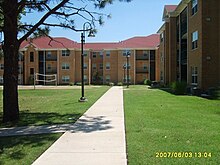
Lawson Court apartments at USAO, which are one of the on-campus housing options
The majority of students live on campus in one of USAO'south three housing options: Sparks Hall dormitories, Lawson Court Apartments, or the historic Robertson Hall.[60] [61] [62] [63]
Students participate in roughly thirty organizations, including political advocacy, religious, academic, and special involvement groups.[64] They are also served past the University'south century-former newspaper "The Trend." In that location are several bookish honor groups on campus.[64] There are multiple music ensembles at USAO, including concert band, jazz band, smaller instrumental ensembles, concert choir, and jazz choir, which are open to majors and non-majors.[65] The University has 1 fraternity, Phi Lambda Chi, and ane sorority, Sigma Psi Omega; as of 2013, approximately 3% of men and 6% of women participated in Greek life.[64] [66] The Educatee Regime and Educatee Activities Lath plan events for all students and guests throughout the year.
The Spring Triad is a major campus event held annually on the first Thursday in April.[67] It includes the Montmartre Chalk Art Festival, the Droverstock music festival, and the Scholastic Meet.[68] [69] The Montmartre Chalk Art Festival, named for the Montmartre arts district in Paris, is held around the USAO Oval, and over 700 artists, including elementary, high school, and college students and community members, have part in the competition.[70] [71] Droverstock is a day-long festival of live music from bands of all styles and genres.[72] There are also many vendors, inflatables, and activities associated with the festival.[72] The Scholastic Meet is an bookish contest for high schoolhouse students; around chiliad students compete every year in a wide range of academic disciplines, which include languages and literature, math, science, social sciences, art, theater, and music.[73] [74]
Athletics [edit]
USAO's intercollegiate athletics program began in the 1973–74 academic year.[75] The teams' nickname, the Drovers, refers to the history of cattle-driving through Chickasha.[75] The university is a member of the National Clan of Intercollegiate Athletics (NAIA), primarily competing in the Sooner Athletic Conference (SAC) since the 2000–01 bookish yr; which they were a member on a previous stint from 1978–79 to 1993–94.[76] The Drovers previously competed in the Red River Athletic Briefing (RRAC) from 1998–99 to 1999–2000; every bit an NAIA Independent during the 1997–98 school year; and the Oklahoma Intercollegiate Conference (OIC) from 1994–95 to 1996–97.
USAO competes in 13 intercollegiate varsity sports: Men'southward sports include baseball, basketball, cross country, golf, soccer and runway & field; while women's sports include basketball game, cross country, golf game, soccer, softball, track & field and volleyball. The academy announced in December 2022 that it would add together women's volleyball in the Fall 2022 trimester.[77]
Accomplishments [edit]
The men's basketball game squad has won the NAIA Briefing title four times, appeared in the National Tournament five times, and won the National Championship in 2002. The Lady Drovers' basketball team played in the NAIA Last 4 in 2003. The men'due south soccer plan is also strong, with the Drovers having won the Briefing Title six times, appeared in the National Tournament twice and made the NAIA National Quarterfinals in 2010. The Lady Drovers' soccer team has as well been the 2006 Tourney Qualifier. Baseball game and Softball are both popular sports on campus, with the Lady Drovers' Softball team being National Tourney Qualifiers three years in a row.
Notable alumni [edit]
- Te Ata (Mary Thompson) graduated from OCW in 1919, famed Chickasaw storyteller and actress.
- Gladys Anderson Emerson, biochemist, the first person to isolate Vitamin East in a pure form and winner of the 1952 Garvan–Olin Medal for women in chemical science, graduated from OCW in 1925.[78]
- Jerrie Cobb, aviator and member of the Mercury 13, attended OCW in 1948.[79]
- Angelene Collins, soprano and 1950 winner of the Walter Due west. Naumburg Contest, graduated from Oklahoma College for Women in 1943.[80]
- Robert E. England, political scientist
- Oisin Fagan Irish professional boxer, attended USAO on a soccer scholarship and received a degree in journalism and physical education.[81]
- Betty Pat Gatliff, pioneer in forensic art and forensic facial reconstruction, graduated from OCW in 1951.[82]
- Inola Henry, chair of the resolutions committee of the California Democratic Party, member of the Democratic National Committee, and superdelegate to the 2008 Democratic National Convention graduated from OCW in 1965.[83]
- Lance Henson, Cheyenne poet, graduated from OCLA in 1972.[84]
- Jeane Porter Hester, Professor of Medicine, Master of Supportive Therapy, and Master of Leukapheresis at Academy of Texas Physician Anderson Cancer Center and developer of the IBM 2997 blood cell separator, graduated from OCW in 1951.[85] [86]
- Kelly D. Johnston, who served equally the 28th Secretary of the Usa Senate, graduated from USAO in 1976.[87]
- Carma Leigh, Land Librarian of California from 1951 to 1972[88]
- Mary Stone McLendon, Chickasaw educator, storyteller, musician, performer, and humanitarian.[89]
- Mary Pannbacker, endowed chair of speech-language pathology at LSU Health Sciences Eye Shreveport and Fellow of the American Speech-Linguistic communication-Hearing Association graduated from OCW in 1963.[90] [91]
- Lotsee Patterson, founder of the American Indian Library Clan, graduated from OCW in 1959.
- Lee Shaw, American jazz pianist and composer, graduated from OCW in 1949.[92]
- Norma Smallwood was crowned Miss America 1926. She was the starting time Native American to win the title.[93] [94]
- James Vernon Smith, U.S. Representative from Oklahoma'southward sixth congressional district and Administrator of the Farmers Home Administration, attended OCLA.[95] [96]
- Hazel Volkart, composer
- Bill Wallace, author of children'due south books, graduated from OCLA in 1971.[97]
Notable faculty [edit]
- Nellie Ellen Shepherd, painter, headed the art department at OWC.[98] Her portrait of Te Ata hangs in the Oklahoma Country Capitol.[99]
- Anna Lewis, historian, headed the history department at OWC. Author of Chief Pushmataha, American Patriot: The Story of the Choctaws Struggle for Survival. Her portrait hung in the Oklahoma State Capitol.
References [edit]
- ^ "University of Science and Arts of Oklahoma Foundation, Inc. - 2022 Form 990"
- ^ "Academy of Science and Arts of Oklahoma: Fall Enrollment Trends," Archived 2015-01-23 at the Wayback Motorcar Academy of Science and Arts of Oklahoma, 2019. Retrieved August 24th, 2020.
- ^ a b "National Register Information System". National Register of Historic Places. National Park Service. July ix, 2010.
- ^ "Member Institutions," Council of Public Liberal Arts Colleges, Retrieved January 21, 2015.
- ^ a b c d "NPS Class 10-900:National Register of Celebrated Places Registration Form: Oklahoma College for Women Celebrated District,", 2001, Accessed January 31, 2015.
- ^ "The Oklahoma State System of Higher Education," Oklahoma State Regents for Higher Education, p.five, Updated November 2013. Accessed March 2, 2015.
- ^ a b Orr, 198
- ^ "Early Years," University of Science and Arts of Oklahoma, Retrieved January nineteen, 2015.
- ^ Jefferies, Angie. "Chickasha", Encyclopedia of Oklahoma History and Culture, 2009. Accessed March two, 2015.
- ^ "Growth of School," University of Science and Arts of Oklahoma, Retrieved January 21, 2015.
- ^ Savage, Cynthia. "University of Science and Arts of Oklahoma", Encyclopedia of Oklahoma History and Civilization.
- ^ Thoburn, Joseph P. A Standard History of Oklahoma. Chicago: The American Historical Society, 1916, p. 1004-1005.
- ^ a b Orr, 201-02
- ^ Orr, 216-217
- ^ Orr, 208
- ^ Litton, Gaston. History of Oklahoma at the Gold Anniversary of Statehood, Volume II, New York: Lewis Historical Publishing Visitor Inc., 1957, p. 317.
- ^ Moon, F.D. "Higher Education and Desegregation in Oklahoma," The Periodical of Negro Education, Vol. 27 No. 3: Summer 1958, p. 301.
- ^ Guzman, Jessie P. Xx Years of Courtroom Decisions Affecting Higher Education in the South: 1938-1958, Tuskegee Institute, Alabama: Tuskegee Institute Department of Records and Enquiry, June 1960, p. 21. Accessed March 20, 2015.
- ^ "OCLA," University of Science and Arts of Oklahoma, Retrieved January xix, 2015
- ^ Coffelt, John J., Dan Southward. Hobbs, and A.J. Brambaugh. "Goals for Oklahoma College Education: Cocky-Report of Higher Education in Oklahoma-Written report 8," Oklahoma Country Regents for College Education, State Capitol, Oklahoma City, September 1966, p. 8. Accessed Jan 31, 2015.
- ^ a b c "Becoming USAO," University of Science and Arts of Oklahoma, Retrieved January xix, 2015
- ^ "USAO Presents Ambitious Mission Enhancement Plan," University of Science and Arts of Oklahoma, May 31, 2005. Accessed March 20, 2015.
- ^ Simpson, Susan. "Unique Mission is Focus of Plan for State Higher," The Oklahoman, Nov 20, 2005.
- ^ McNutt, G.S. "Pillar of Strength," The Oklahoman, Nov 3, 2014. Accessed March xx, 2015.
- ^ a b Lane, Jessica. "World renowned sculptor builds USAO park with students," Limited-Star (Chickasha, OK), May twenty, 2015. Accessed June 2, 2015.
- ^ Griffin, Andrew W. "Granite sculptor Jesús Moroles helps USAO students, campus 'come together,'" Red Dirt Study, May twenty, 2015. Accessed June two, 2015.
- ^ National Register of Historic Places - Grady County, Oklahoma (accessed March 16, 2010).
- ^ National Annals Properties in Oklahoma: Oklahoma College for Women Historic Commune Archived 2010-06-20 at the Wayback Car (accessed March 16, 2010).
- ^ "The American Indian Arts and Humanities Project," Archived 2015-01-23 at the Wayback Machine University of Science and Arts of Oklahoma, Retrieved January 22, 2015.
- ^ Jim Gabbert, "v Buildings by John Duncan Forsyth", Preservation Oklahoma News, July 2006, p.5.
- ^ McNutt, Kathryn. "Oklahoma University's Outdoor Classroom Gets Boost to Foster Education, Inspiration, Recreation," The Oklahoman, February iii, 2015. Accessed February 13, 2015.
- ^ "The Oklahoma State Organisation of Higher Education," Oklahoma State Regents for Higher Pedagogy, p.four, Updated Nov 2013. Accessed March 2, 2015.
- ^ Harlow, 52.
- ^ a b "USAO Board of Regents," University of Scientific discipline and Arts of Oklahoma, Accessed March ii, 2015.
- ^ "Our President," University of Science and Arts of Oklahoma, Accessed March ii, 2015.
- ^ a b USAO'southward Mission Statement "Mission & Objectives," University of Science and Arts of Oklahoma, Retrieved Jan 21, 2015.
- ^ a b Slipke, Darla. "Academy of Scientific discipline and Arts of Oklahoma makes strides with mission enhancement plan," NewsOK, Oct viii, 2011. Retrieved January 21, 2015.
- ^ a b "Sectionalization of Interdisciplinary Studies (IDS)," University of Science and Arts of Oklahoma, Retrieved January 21, 2015.
- ^ McNutt, K.S. Colonnade of Strength," The Oklahoman, November 3, 2014. Accessed January 21, 2015.
- ^ "2014-2016 Class Catalog," Archived 2015-01-22 at the Wayback Auto University of Scientific discipline and Arts of Oklahoma, p. 47. Accessed January 21, 2015.
- ^ "Counselors' Resource Book," Oklahoma State Regents for High Education, 2014-2015, p.63. Retrieved January 21, 2015.
- ^ "2014-2016 Course Catalog," Archived 2015-01-22 at the Wayback Machine University of Science and Arts of Oklahoma, p. 22. Accessed January 22, 2015.
- ^ "2014-2016 Course Itemize," Archived 2015-01-22 at the Wayback Machine University of Scientific discipline and Arts of Oklahoma, p. 46. Accessed January 22, 2015.
- ^ a b c d "Price of Omnipresence," Archived 2015-02-20 at the Wayback Motorcar University of Science and Arts of Oklahoma, Accessed February 19, 2015.
- ^ "Regent Corroborate Sweeping Tuition Structure Changes; $12.9M Budget," Archived 2015-02-20 at the Wayback Machine, University of Scientific discipline and Arts of Oklahoma, June 20, 2014. Accessed Feb 19, 2015.
- ^ KFOR-Television and L. Noland. "Three More State Campuses Moving to Apartment-Rate Tuition," KFOR, June xxx, 2014. Accessed February 19, 2015.
- ^ Oklahoma State Regents for College Teaching. FY2013-14 Tuition Impact Analysis Report. Oklahoma City: Oklahoma State Regents for Higher Education, December 2013, p. 10, 85. Accessed February nineteen, 2015.
- ^ a b "Financial Aid," University of Science and Arts of Oklahoma, Accessed Feb 19, 2015.
- ^ "Best Values in Colleges: University of Science and Arts of Oklahoma," Kiplinger, Dec 2015. Accessed January 13, 2015.
- ^ American Council of Trustees and Alumni. "University of Scientific discipline and Arts of Oklahoma, What Will They Learn?, Retrieved January 22, 2015.
- ^ American Council of Trustees and Alumni. "Rating Criteria," What Will They Learn?, Retrieved January 22, 2015.
- ^ "Viewbook," Archived 2015-01-23 at the Wayback Motorcar, University of Science and Arts of Oklahoma, Retrieved January 22, 2015.
- ^ "What Will They Learn? 2014-2015," American Council of Trustees and Alumni, 2014, p. 93-94. Retrieved January 22, 2015.
- ^ American Council of Trustees and Alumni. "A Listing," What Volition They Learn?, Retrieved January 22, 2015.
- ^ "Currently or Previously Affiliated Institutions: University of Science and Arts of Oklahoma," Higher Learning Commission: A Commission of the N Cardinal Clan, Updated November eighteen, 2014. Retrieved Jan 22, 2015.
- ^ "Accredited Institution Details: The University of Science and Arts of Oklahoma," NCATE: The Standard for Excellence in Teacher Preparation, Retrieved January 22, 2015.
- ^ "Accreditation Status," Office of Educational Quality and Accountability, Retrieved January 22, 2015.
- ^ "Deaf Education Teacher Preparation Programs: Oklahoma," Deaf Education: Educational Advocacy for the field of Deafened Instruction, Updated March 2014. Retrieved January 22, 2015.
- ^ "University of Science and Arts of Oklahoma," Archived 2015-01-23 at the Wayback Automobile National Association of Schools of Music, Retrieved January 22, 2015.
- ^ "University of Science and Arts of Oklahoma: Fall Enrollment Trends," Archived 2015-01-23 at the Wayback Machine Academy of Science and Arts of Oklahoma, 2014. Retrieved January 22, 2015.
- ^ "Residence Life," University of Science and Arts of Oklahoma, Retrieved January 21, 2015.
- ^ "Sparks Hall," University of Science and Arts of Oklahoma, Retrieved January 22, 2015.
- ^ "Lawson Court," University of Science and Arts of Oklahoma, Retrieved January 22, 2015.
- ^ a b c "Clubs and Organizations," Archived 2015-04-02 at the Wayback Motorcar University of Science and Arts of Oklahoma, Accessed March 9, 2015.
- ^ "Ensembles," Archived 2015-04-02 at the Wayback Automobile University of Science and Arts of Oklahoma, Accessed March 9, 2015.
- ^ "Academy of Science and Arts of Oklahoma: Student Life," U.S. News and World Report, based on 2013 data. Accessed March 9, 2015.
- ^ "Spring Triad Events Describe Thousands to USAO Campus" Archived 2015-01-29 at archive.today, University of Science and Arts of Oklahoma, April 9, 2014. Accessed January 28, 2015.
- ^ Snyder, Rachel. " Annual Drover concert begins today," The Express-Star, April iii, 2014. Accessed January 28, 2015.
- ^ la terra studio. "Chickasha, Grady Canton, Oklahoma: Park System Main Plan," [ permanent expressionless link ] Chickasha Parks and Recreation Section, July 24, 2013, p. xiii. Accessed Jan 28, 2015.
- ^ Coppernoll, Carrie. "USAO sidewalk chalk festival draws out inventiveness in Chickasha," NewsOK, April 13, 2011. Accessed January 28, 2015.
- ^ Vollmar, Rob. "Chalk art festival sends out call to Oklahoma artists," The Express-Star, January 26, 2015. Accessed Jan 28, 2015.
- ^ a b "Droverstock 2015," University of Science and Arts of Oklahoma, Accessed January 28, 2015.
- ^ Snyder, Rachel. "Southmoore takes first at USAO scholastic meet," The Express-Star, April 6, 2014. Accessed January 28, 2015.
- ^ "Scholastic See 2015," University of Science and Arts of Oklahoma, Accessed January 28, 2015.
- ^ a b "Drover History," University of Science and Arts of Oklahoma," Retrieved January 22, 2015.
- ^ "University of Science and Arts of Oklahoma,", Sooner Able-bodied Briefing, Retrieved January 22, 2015.
- ^ McWilliams, Joey. "USAO to add together volleyball in 2016," Oklahoma Sports Net, December fourteen, 2015. Accessed April xv, 2016.
- ^ Folkers, Karl (1985). "Gladys Anderson Emerson (1903-1984): A Biographical Sketch," Journal of Nutrition: 837-41.
- ^ "Cobb, Jerrie 2003," University of Science and Arts of Oklahoma, Accessed April 2, 2015.
- ^ "Angelene Collins Will Give Concert," Oklahoman, April 21, 1951, p.19.
- ^ Hogan, Vincent (28 November 2008). "Cinderella Human of Dublin". Irish Independent . Retrieved 23 May 2017.
- ^ "Gatliff, Betty Pat 1978," Academy of Scientific discipline and Arts of Oklahoma, Accessed Feb 19, 2016.
- ^ Woo, Elaine. "Inola Henry dies at 66; teacher and California Democratic activist," Los Angeles Times, August v, 2009. Accessed May 23, 2016.
- ^ Arnett, Gogisgi Carroll. "Lance (David) Henson," Handbook of Native American Literature. Wiget, Andrew, ed. Taylor & Francis, 1996, p.445. ISBN 0-8153-1560-0
- ^ "Hester, Jeane Porter 1976," Academy of Science and Arts of Oklahoma. Accessed May 25, 2016.
- ^ Hester, Jeane P. and Gail Rock. "Cohn de Laval Accolade Lectureship: The Science Behind the Success Development of a Continuous Flow Blood Cell Separator," Transfusion and Apheresis Scientific discipline, Volume 52, Result 1 (February 2015), Pages 2–7.
- ^ Transcript. Kelly D. Johnston: Staff Director, Senate Republican Policy Committee, and Secretary of the Senate. Oral History Interviews. July 29, 1996 - February x, 1997. Washington D.C.: Senate Historical Office, p. i-ii. Senate.gov. Accessed March twenty, 2015.
- ^ Mediavilla, Cindy (Winter 2004). "Imbued with a Spirit of Cooperation: California Country Librarian Carma Leigh" (PDF). California State Library Foundation Bulletin. 79: two–five.
- ^ Nash, Margaret A. (2017). Women's Higher Didactics in the United States: New Historical Perspectives. Springer. p. 194. ISBN9781137590848.
- ^ "A New Listing: Where are They Now?" The Trend, University of Science and Arts of Oklahoma, November 9, 1989, p.6. Accessed July 9, 2016
- ^ "Tribute for Mary Pannbacker," Perspectives on Speech and Oral Facial Disorders, Volume 25, July 2015, p.44. Accessed July nine, 2016. doi:x.1044/ssod25.1.44
- ^ "Shaw, Londa Lee Moore 1999," University of Scientific discipline and Arts of Oklahoma. Accessed February 19, 2017.
- ^ Lester, Terrell. "Reigning Queen//Sometime Tulsan Won 1926 Miss America Title," Tulsa World, April 6, 1997. Accessed March 20, 2015.
- ^ "Miss America of 1926" OCW Trend, Oct seven, 1926. Accessed March 20, 2015.
- ^ Hanneman, Carolyn Chiliad. "Smith, James Vernon," Encyclopedia of Oklahoma History and Culture, 2009. Accessed March xx, 2015.
- ^ "Smith, James Vernon, (1926 - 1973)," Biographical Lexicon of the United States Congress, congress.gov, Accessed March 20, 2015.
- ^ "Bill Wallace Biography," The Wallace Family Writers, Accessed Jan 31, 2015.
- ^ "Shepherd, Nellie Ellen - The Encyclopedia of Oklahoma History and Culture". Retrieved 14 February 2017.
- ^ Council, Oklahoma Arts. "Te Ata by Nellie Ellen Shepherd Visual Art Details and Symbolism". Retrieved fourteen February 2017.
Sources [edit]
- Harlow, Rex (1927). George W. Austin: His Life and Work. Oklahoma City, Oklahoma.
- Orr, Milton Lee (1930). The State-Supported Colleges for Women. Nashville, Tennessee: George Peabody College for Teachers.
External links [edit]
- Official website
- Official athletics website
Coordinates: 35°01′53″N 97°57′17″W / 35.03139°N 97.95472°Due west / 35.03139; -97.95472
Source: https://en.wikipedia.org/wiki/University_of_Science_and_Arts_of_Oklahoma

Post a Comment for "University of Science and Arts of Oklahoma Student Union"